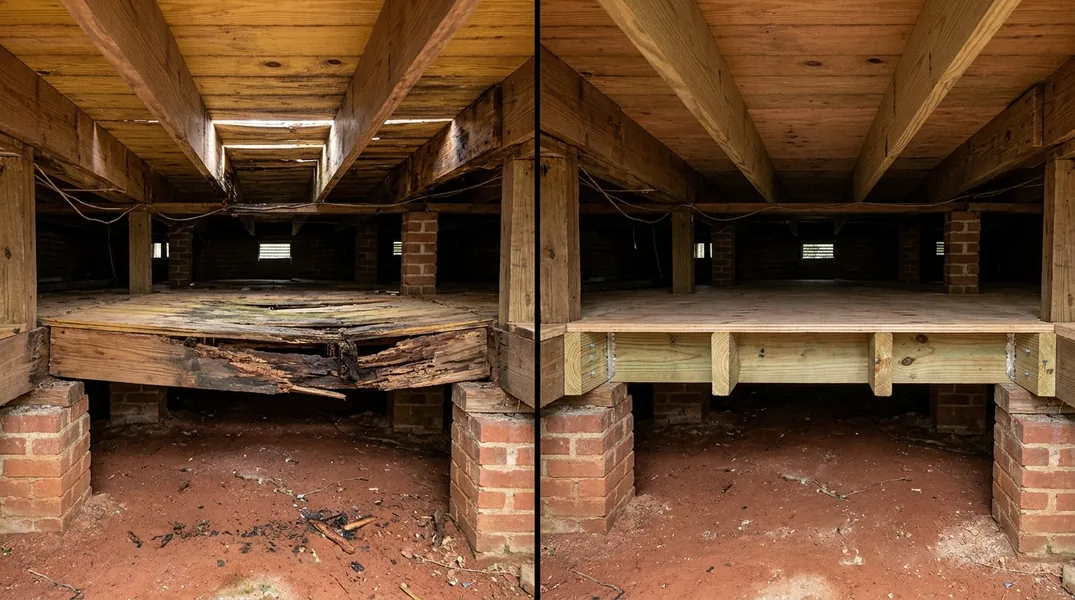
Why Are Your Floors Sagging? Common Causes in Older Montgomery Homes
If you own an older home in Montgomery, you've probably noticed that distinctive bounce or dip in your hardwood floors. That spongy feeling underfoot isn't just an annoyance, it's a warning sign that something structural is failing beneath your home. The most common culprit? Water damage and rot in the crawlspace.
Older homes, especially those built before modern moisture barriers became standard, are particularly vulnerable to crawlspace moisture problems. When groundwater seeps in, it creates the perfect environment for wood-destroying fungi and decay. The floor joists, which bear the weight of your entire first floor, begin to lose their structural integrity as the wood softens and deteriorates. Over time, this decay causes the joists to sag, and the whole floor system settles unevenly. Brick piers, which support many Montgomery area homes, can also shift or crack due to soil erosion or settling, contributing to floor deflection. Understanding what's happening beneath your floors is the first step toward getting a real fix.
Crawlspace Moisture: The Silent Destroyer of Floor Joists
The crawlspace is often the forgotten zone of a home, and that's exactly why moisture problems there can become so severe. Without proper ventilation, drainage, or a vapor barrier, humidity builds up in the crawlspace and creates conditions where wood rot thrives. When relative humidity stays above 60 percent for extended periods, wood-destroying organisms move in and begin their slow but relentless work of breaking down the cellulose fibers that give joists their strength.
Many homeowners don't realize that crawlspace moisture doesn't just damage wood directly. It also creates an environment where termites and other wood-boring insects flourish, potentially leading to Termite Damage Repair needs on top of rot issues. The combination of moisture and pest damage can compromise joists far more quickly than moisture alone. If you've noticed a musty smell in your home, visible mold in the crawlspace, or condensation on pipes and ductwork, you likely have a moisture problem that needs immediate attention. Addressing crawlspace moisture is not just about saving your floors, it's about protecting your entire home's foundation and structural integrity.
Understanding Floor Joist Repair and Sistering Floor Joists
When floor joists become compromised by rot or damage, homeowners often wonder if the entire joist must be replaced. In many cases, the answer is no. A technique called sistering floor joists allows experienced carpenters to reinforce a damaged joist by fastening a new, pressure-treated board alongside the existing one. This method is cost-effective and often less invasive than full replacement, especially when the joist damage is localized to one section rather than running the full length of the board.
The sistering process involves carefully installing a new joist that's the same dimensions as the original, fastening it securely with bolts, nails, and construction adhesive to create a unified structural member. This distributes the load across both pieces of wood, restoring the floor's strength and eliminating the sag. However, sistering isn't always the right solution. If a joist is severely rotted along most of its length, or if multiple joists are damaged, full replacement or more comprehensive Floor Joist & Subfloor Repair may be necessary. A professional inspection can determine which approach will give you the most durable, long-lasting results. The key is catching the problem early, before structural damage becomes too extensive.
Brick Piers, Foundation Settling, and Sagging Floors
Many older homes in the Montgomery area were built on brick pier and beam foundations rather than modern concrete slabs or continuous foundations. While this construction method allowed for good ventilation and easier access to utilities, it also introduced a vulnerability: brick piers can crack, shift, or settle unevenly over decades. When a pier fails or moves, it no longer provides adequate support to the beam it's supposed to carry, and the floor system above begins to sag.
Identifying pier-related floor sag requires looking at the pattern of the sag. If the floor slopes toward one area of the home, or if you notice that the sag is localized rather than gradual across the entire floor, a foundation issue may be the culprit. Soil erosion, changes in moisture levels beneath the home, or simply the weight of decades bearing down on the masonry can all cause piers to fail. In some cases, piers need to be rebuilt or reinforced with concrete. In others, the beam itself needs replacement or additional support posts. This type of work often requires coordination with Beam Replacement & Load-Bearing Wall Removal specialists to ensure the structural integrity of the entire home is maintained during repairs.
Real Fixes: What a Professional Sagging Floor Repair Involves
A genuine solution to sagging floors starts with a thorough inspection. A professional carpenter will examine the crawlspace, test wood samples for moisture content and rot, inspect the foundation and piers, and assess the condition of every joist that might be affected. This diagnostic work is essential because the visible sag is just a symptom, the real problem lies in identifying the root cause. Is it moisture? Rot? Foundation movement? Pest damage? The answer determines the repair strategy.
Once the cause is identified, the repair process typically involves multiple steps. First, the moisture problem must be addressed, whether through improved crawlspace ventilation, a vapor barrier installation, or drainage improvements. Next, damaged wood is either reinforced through sistering, replaced entirely, or supported with additional posts or beams. In cases where the foundation is the issue, piers may be rebuilt or supplemented with concrete pads and additional support posts. Finally, the floor system is carefully jacked back to level or near-level, a process that must be done gradually to avoid cracking walls or damaging the structure. This comprehensive approach ensures that your floors not only look better but are structurally sound and protected against future problems.
Sagging Floor Repair Cost in Montgomery: What to Budget
The cost of sagging floor repair varies dramatically depending on the extent of the damage, the cause, and the repair method required. A simple sistering job on one or two joists might cost significantly less than replacing multiple rotted joists or rebuilding foundation piers. Addressing crawlspace moisture issues, while important for long-term protection, also adds to the overall project cost. Most homeowners should expect that a comprehensive sagging floor repair will be a substantial investment, but the cost of doing nothing is far higher, both in terms of worsening damage and potential safety hazards.
The best way to understand what your specific repair will cost is to schedule a free estimate with Montgomery Carpentry. A professional inspection will give you a clear picture of what's wrong and what it will take to fix it properly. You can reach us at (334) 721-7938 to arrange an appointment. We serve homeowners throughout the Montgomery area and can provide transparent pricing based on your home's specific needs. Investing in a proper repair now prevents exponentially more expensive damage down the road.
Looking for a professional carpentry contractor in Montgomery? Montgomery Carpentry responds fast for all your carpentry needs.
Get a Free QuoteOur services: Wood Rot & Dry Rot Repair · Termite Damage Repair · Floor Joist & Subfloor Repair